Printable vs Reusable vs Tear-Off: Which Potty Training Chart Actually Works?
Nina OttmanIf you’ve ever Googled “potty training chart” at 10pm while questioning all your life choices… you’ve probably seen all three options.
Printable.
Reusable.
Tear-off.
And they all do the job, right? They all work.
So how do you know which one will work best when you're knee-deep in it trying to maintain consistency and your sanity at the same time?
Let’s break down your options and how you will actually experience them in real life.

1. Printable potty training charts (the “free/cheap” option)
Printable charts are usually the first stop. They’re easy to find, easy to download, and feel like a low-commitment way to get started. (Even Letter & Line has a PDF potty chart.)
What's awesome about them:
- Free or very inexpensive
- Tons of design options
- Easy to replace if one gets messy/torn/lost
What's not so awesome:
- You have to print it… every single day (or week)
- You run out of ink at the worst possible time
- You forget to print it until you need it
- It turns into one more invisible task on your plate
And this is where you start wondering how much paper your family is burning through, when your child is going to "get it," and how much longer you have to carry the mental load of printing all of the things.
Potty training isn’t complicated in theory, but the minute you start adding tasks —tracking, printing, rewarding, relaying information to and from daycare— it's a whole different game. And it adds up fast.
On the other hand, if you love systems and already have a smooth home workflow, a printable potty chart can be a simple, cost-effective option without committing to a bigger setup.
2. Reusable potty charts (the “sounds efficient” option)
Reusable charts usually mean laminated sheets, dry-erase boards, or magnetic systems you reuse day after day.
On paper (no pun intended), this sounds like the most efficient choice.
What works:
- No daily printing
- Eco-friendly
- Feels structured and intentional
- Can be used long-term
- There are some really cute sets out there
Where it gets tricky:
- You have to reset it… consistently
- Markers go missing (or end up on walls, furniture, or little hands)
- Magnets wander (and somehow always end up under the fridge)
- It’s easy to accidentally wipe or knock things out of place
- Small pieces can become one more thing you have to keep an eye on
And this is where real life starts creeping in.
It’s not just about remembering to reset the chart.
It’s about managing all the parts that come with it.
A marker left uncapped.
A magnet that disappears mid-day.
A chart that gets bumped and suddenly everything is out of place.
None of these are dealbreakers on their own.
But together, they add just enough friction to matter.
Reusable systems can absolutely work.
But they rely on a level of upkeep that’s easy to underestimate… especially in a house with a toddler.
And if the system stops feeling easy to maintain, it’s usually the first thing to fall by the wayside (so much for long-term use).

3. Tear-off potty training charts (the “happy medium” option)
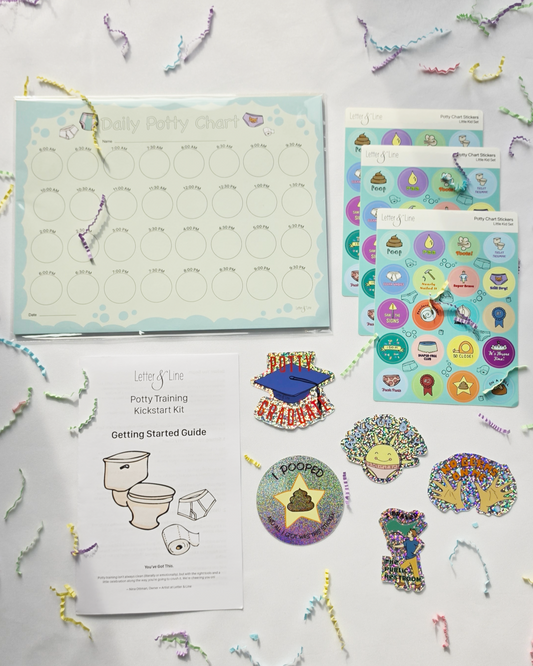
Tear-off potty training charts sit right in the middle between printable and reusable systems.
You get the reliability of paper and stickers… without having to print a new chart every day.
What works:
- No daily printing
- No resetting or wiping anything down
- Nothing small to keep track of (no loose magnets or markers)
- Clean, fresh start each day (or week) with zero effort
- Clear, simple visual your child can follow
Why this works so well in real life:
It removes the in-between steps.
You’re not pausing to print.
You’re not resetting a chart.
You’re not fixing something that got bumped or wiped away.
You just use it… and when you’re done, you tear it off and move on.
That might sound small, but it changes how the whole day feels.
Because potty training happens in moments.
The 8am “I ran to the potty!” moment.
The mid-day “I told you I had to go!” moment.
And in those moments, you want to be ready to notice it, celebrate it, and reinforce it.
Not scrambling to set the system back up.
That’s where a simple potty training chart with stickers really starts to shine. The system stays consistent, the expectations stay clear, and your focus stays where it should be… on your child learning the skill.
4. Choose the system you can actually keep up with
At a certain point, this stops being about which potty training chart looks best… and starts being about how it fits into your actual day.
Because you’re not using this chart in a calm, perfectly planned environment.
You’re using it:
- While getting everyone out the door in the morning
- While juggling meals, work, and everything else on your plate
- While coordinating between daycare, partners, or other caregivers
And that’s where the real question shifts.
Not: “What’s the cheapest option?”
Not: “What looks the most put together?”
But: “What system can I realistically keep up with every day?”
Because the more effort a system requires from you, the more it adds to your mental load.
And when your mental load is already high, even small tasks start to feel overwhelming.
That’s the part that matters.
When you’re stretched thin, your patience gets shorter. Your reactions get quicker. And potty training is one of those phases that will test both.
So the goal isn’t to find the “perfect” system. It’s to find one that supports you just as much as it supports your child.

Potty training doesn’t need to be complicated to work.
What matters most is that your system is consistent, easy to use, and doesn’t ask more from you than your day can give.
Whether that’s a printable, a reusable setup, or a tear-off chart, the best choice is the one that helps you stay present in the moment… especially during the messy parts.
Because those small, everyday moments are where the learning actually happens.
And when your system makes it easier to show up for them, everything else starts to fall into place.