How to Potty Train a Toddler When You’re Not the Only Caregiver
Nina OttmanThere’s this phrase we all hear: it takes a village.
And it’s true… right up until you’re trying to potty train and suddenly the “village” feels like five different strategies happening at once.
Daycare does one thing.
Grandma does another.
You’re trying to stay consistent at home… but it’s starting to feel like you’re the only one keeping track of what’s working.
And now you’re wondering if the problem is your toddler… or the lack of alignment.
(It's not your toddler.)
Potty training is about repetition in a consistent environment, and when multiple caregivers are involved that consistency has to be intentional.

1. Start with the goal (not the method)
Everyone loves to jump straight to how they’re doing it… instead of agreeing on what you’re trying to achieve right now.
Are you working toward:
- Awareness of needing to go?
- Sitting on the potty at regular times?
- Independence with pulling pants down and up?
Different potty training methods can still support the same goal.
But if the goal itself isn’t clear, every caregiver ends up making their own call in the moment.
And that’s where things get messy.
Instead of trying to get everyone to follow the exact same method, start here:
“Here’s what we’re working on right now.”
It gives everyone a shared direction without turning it into a rulebook.
2. Create a shared language around potty training
Toddlers learn easiest through pattern and repetition.
So when the language changes, the expectations feel like they’re changing too.
If one caregiver says: “Tell me when you need to go potty”
And another says: “Let’s try sitting on the toilet”
And another says: “Do you have to pee?”
Your child is getting three different cues for the same thing. Is it peeing, pottying, or toileting? What are we even talking about?
It doesn’t break the process… but it sure can slow things down.
A simple fix is choosing a few consistent phrases:
- “Let me know when your body needs to go”
- “Time to try the potty”
- “You listened to your body”
Your goal should be to create a shared vocabulary amongst caregivers, so your child always knows what they mean.
This is also where writing it down helps more than people expect. A simple caregiver communication form (even a quick fillable one you can share digitally) makes it easy for everyone to stay aligned without constant back-and-forth.

3. Make the invisible visible (what “I need to go” actually looks like)
Every toddler has tells.
The problem is… they’re not always obvious unless you’ve been watching closely.
It might look like:
- Pausing mid-play
- Hiding behind furniture
- Getting suddenly wiggly or quiet
- Grabbing at clothing
If one caregiver recognizes those signs and another doesn’t, you end up with very different outcomes… even if everyone is trying equally hard.
This is one of the most helpful things you can share with your “village”:
“This is what it looks like when they need to go.”
Because once everyone can spot it, they can respond in the same moment.
And that’s where real progress starts to build.
4. Decide ahead of time how to handle wins and accidents
This one matters more than most people think.
Inconsistency here can be very confusing for your child who is trying to understand expectations at the same time as they are practicing a new skill.
If one caregiver celebrates and another stays neutral…
If one reassures and another shows frustration…
Your toddler doesn’t know what the outcome means.
You need alignment.
For example:
- Success = simple, positive recognition (“You did it,” sticker, high five)
- Accident = calm, matter-of-fact response (“Your body is still learning”)
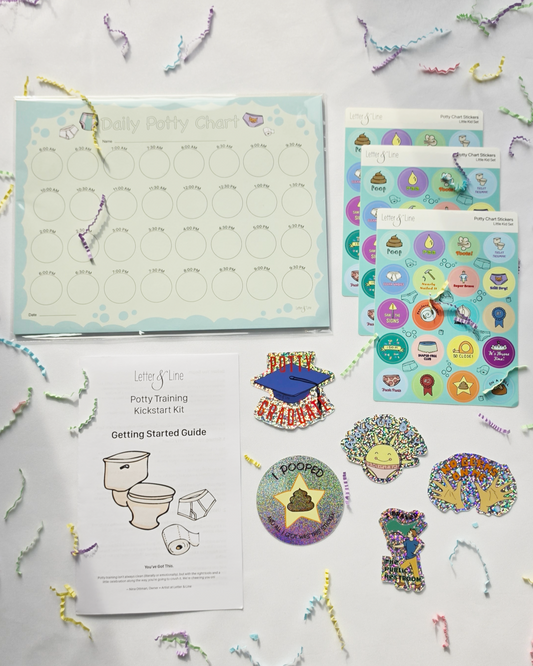
This is where something like potty training reward stickers can actually help unify the experience. It gives every caregiver the same, simple way to recognize progress… without overthinking it.
And more importantly, it keeps the focus on learning, not pressure.

5. Keep communication simple enough to actually maintain
This is often the hardest part of getting your village on the same page.
You start with great communication… and then life gets busy.
So instead of building something complicated, think:
What can we realistically keep up with?
That might look like:
- A quick daily check-in (“any accidents today?”)
- A shared note or form everyone updates
- A simple chart that travels between home and daycare
The goal isn’t perfect documentation.
It’s just enough information to keep everyone on the same page.
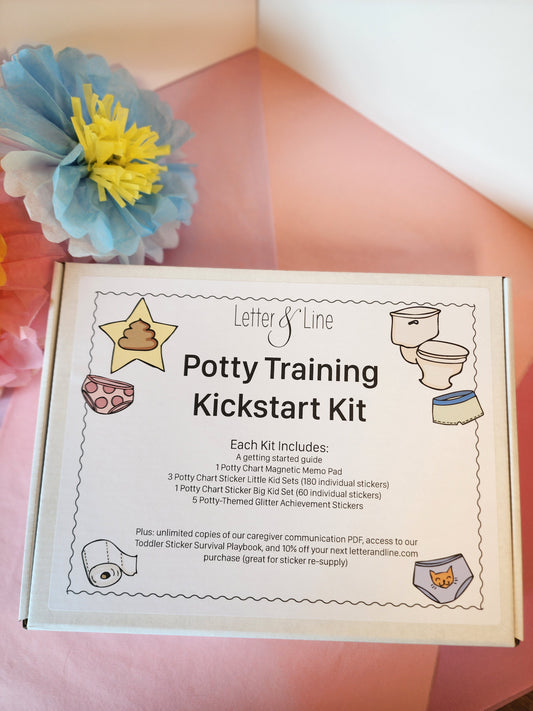
This is exactly why tools like a caregiver communication form or a simple, consistent system (like what’s included in the Potty Training Kickstart Kit) tend to work well.
They reduce the amount of explaining you have to do… over and over again.
And when communication is easier, consistency follows.
Potty training with multiple caregivers can feel like trying to coordinate a group project where no one got the same instructions.
But most of the time, it’s not a disagreement problem.
It’s a communication gap.
Your village wants to help.
They just need clarity on how to support what you’re already doing.
When everyone shares the same goal, uses similar language, and responds in a consistent way, your child gets something really powerful:
A clear, steady learning environment… no matter who they’re with.
And that’s what actually moves things forward.
It doesn’t have to be perfect.
It just has to be connected.
You’re building that connection one conversation at a time.